
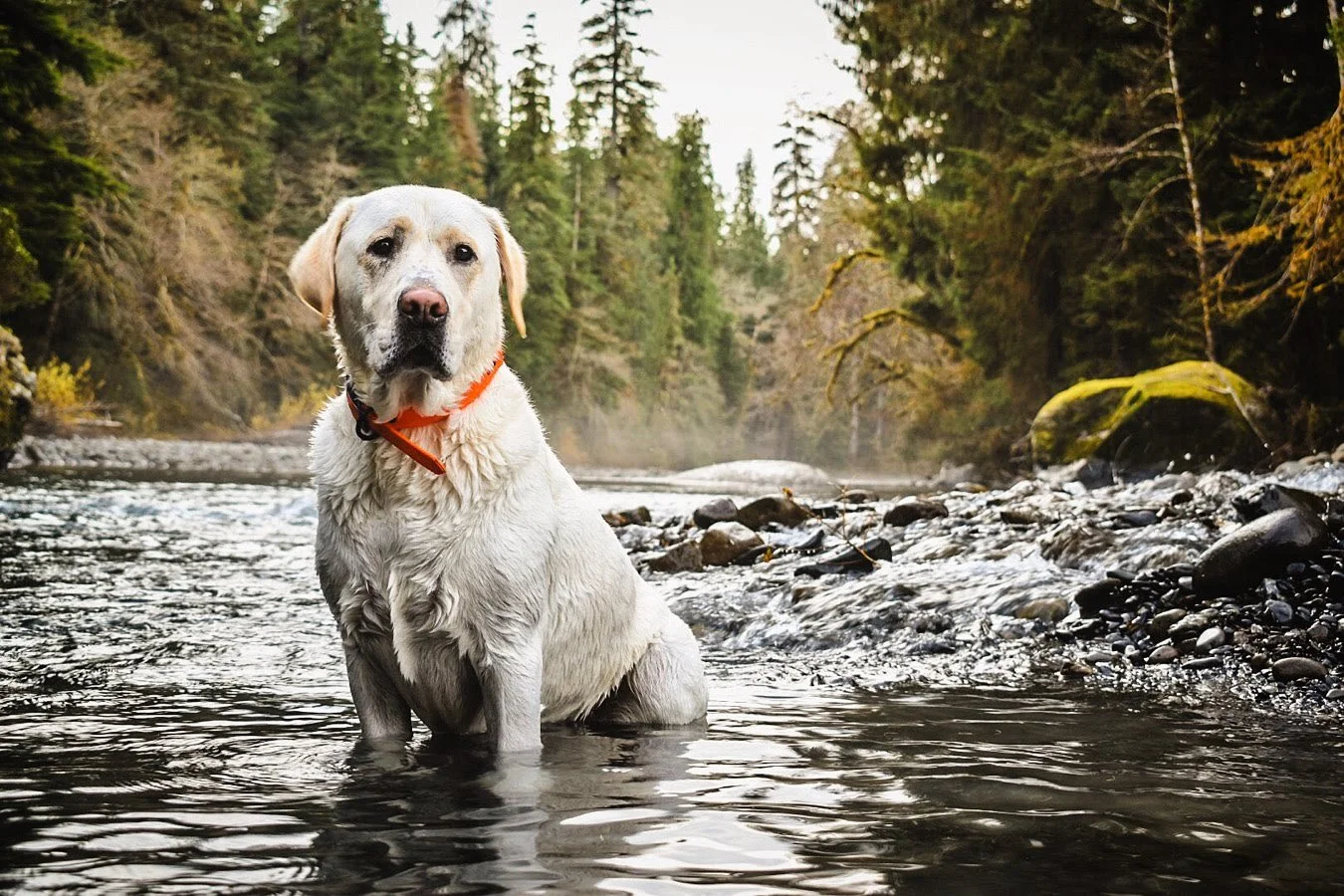
Clay sitting in the icy cold Sol Duc wondering when we are headed home to supper time.
In Forks Pt. 1, I wrote about the long, wet road that brought me from northern New Mexico to the Olympic Peninsula, from dry desert air and Rio Grande trout water to rainforest, salmon, and a fisheries job with the Quileute Tribe that changed the way I looked at rivers.
That first story was really about the move.
This one is about the water.
Because once I settled into Forks and La Push, I started to realize that the rivers around that corner of Washington were not just background scenery. They were the center of everything. They shaped the work, the weather, the towns, the fishing, the culture, and eventually, the early foundation for what Clay’s Drift would become.
Most people still hear Forks, Washington, and immediately think of vampires.
Fair enough. That whole thing had a pretty good run, and to this day folks from all over still travel to Forks in hopes of finding vampires, wolves, and whatever else Twilight left behind.
But for me, Forks was never really about that.
Forks was rain gear that never fully dried, muddy boots in the back of a truck, fog hanging low in the timber, and rivers that always seemed louder than whatever was going on in my own head. It was early mornings and late nights on the river, long field days, wet dogs, cold hands, and learning very quickly that “waterproof” is more of a marketing term than an actual promise on the Olympic Peninsula.
Forks gets an average of around 140 inches of rain a year, which is the kind of number that does not fully register until you live there. For context, if that fell as snow, you would be talking about roughly 1,400 inches, or more than 116 feet. In other words, Forks does not really have weather. It has a personality disorder with precipitation.
It was also where I worked for the Quileute Tribe as a fish habitat biologist, trying to help get habitat restoration work moving in a watershed where salmon and steelhead are not just fish. They are culture, food, family, identity, economy, and responsibility.
That work changed the way I looked at rivers, but it also changed the way I looked at forests.
Around Forks, you cannot really talk about rivers without talking about timber. The forests and the rivers are tied together, not just ecologically, but culturally and economically. Timber helped shape the Olympic Peninsula, and it still supports families, jobs, local businesses, and working communities, especially in Forks. These are working forests, and that matters. We need timber, we need rural economies, and we need people to be able to make a living in places like Forks.
At the same time, many of these river systems still carry the legacy impacts of older logging practices. Past road networks, stream crossings, harvest methods, sediment delivery, reduced riparian shade, and the historic simplification of stream channels changed how some streams functioned for salmon, steelhead, coastal cutthroat, and the smaller fish and aquatic life that hold the food web together. Those impacts did not happen overnight, and they are not fixed overnight either. They show up in how channels move, how gravel settles, how pools form, how cold water is maintained, and whether fish have enough cover and complexity to survive.
The encouraging part is that forest practices have changed a lot over time. Timber companies, Tribes, agencies, land managers, and restoration practitioners now have a much better understanding of how forestry and fish habitat are connected. Modern forest practices place more emphasis on riparian buffers, road drainage, culvert design, sediment control, shade retention, and protecting the processes that keep streams cold, clean, and connected.
So this story is not about blaming timber. It is about understanding the full watershed.
It is about recognizing that forests, rivers, fish, people, and local economies are all connected. The challenge is not choosing between timber and salmon. The challenge is figuring out how working forests and healthy rivers can exist together, because on the Olympic Peninsula, they have to.
That is what made the rivers around Forks so fascinating to me. The Quillayute, the Sol Duc, the Bogachiel, the Calawah, and the Hoh are all close enough that you can build a life around them, but they are not the same river wearing different names. Each one has its own shape, mood, flow, sediment, forest connection, and fish story.
That is where this piece of Along the Drift is headed.
Not into a full fisheries biology lecture, because nobody came here to feel like they accidentally enrolled in an introductory fisheries course. But I do want to pull back the curtain a little and show why these rivers are so unique, why they fish differently, why they feel different when you stand beside them, and why protecting them matters far beyond the person holding the rod.
Around Forks, these watersheds support coho salmon, Chinook salmon, often called king salmon, pink salmon, sockeye salmon, occasional chum salmon, steelhead, coastal cutthroat, and plenty of other aquatic life that does not usually get the same spotlight. To someone who does not spend their free time thinking about fish, that may sound like a list of names you would see on a hatchery sign. But each fish uses the watershed a little differently, and that is where things get interesting.
Coho are often tied closely to smaller streams, side channels, wetlands, and slower water where young fish can tuck away and grow. Chinook are the heavyweights, the big kings that need access to larger river habitat and clean spawning areas. Pink salmon come in with their own timing and rhythm, reminding you that salmon runs can feel both predictable and mysterious. Sockeye are different because their life history is often connected to lake systems, which makes them more specialized than people realize. Chum, when they show up, are often tied to lower-gradient habitat closer to tidewater. Steelhead are the ocean-going rainbow trout that feel almost mythical because they can return from saltwater built like chrome and still act like they have a personal grudge against your fishing plans. Coastal cutthroat might not always get the same attention, but they are one of those fish that make small streams, estuaries, and connected habitats feel alive in a quieter way.
That is the thing about the Olympic Peninsula. The rivers are not supporting one fish in one way. They are supporting different species, different life histories, different habitat needs, and different seasons of movement throughout the year.
And the rivers themselves are just as different.
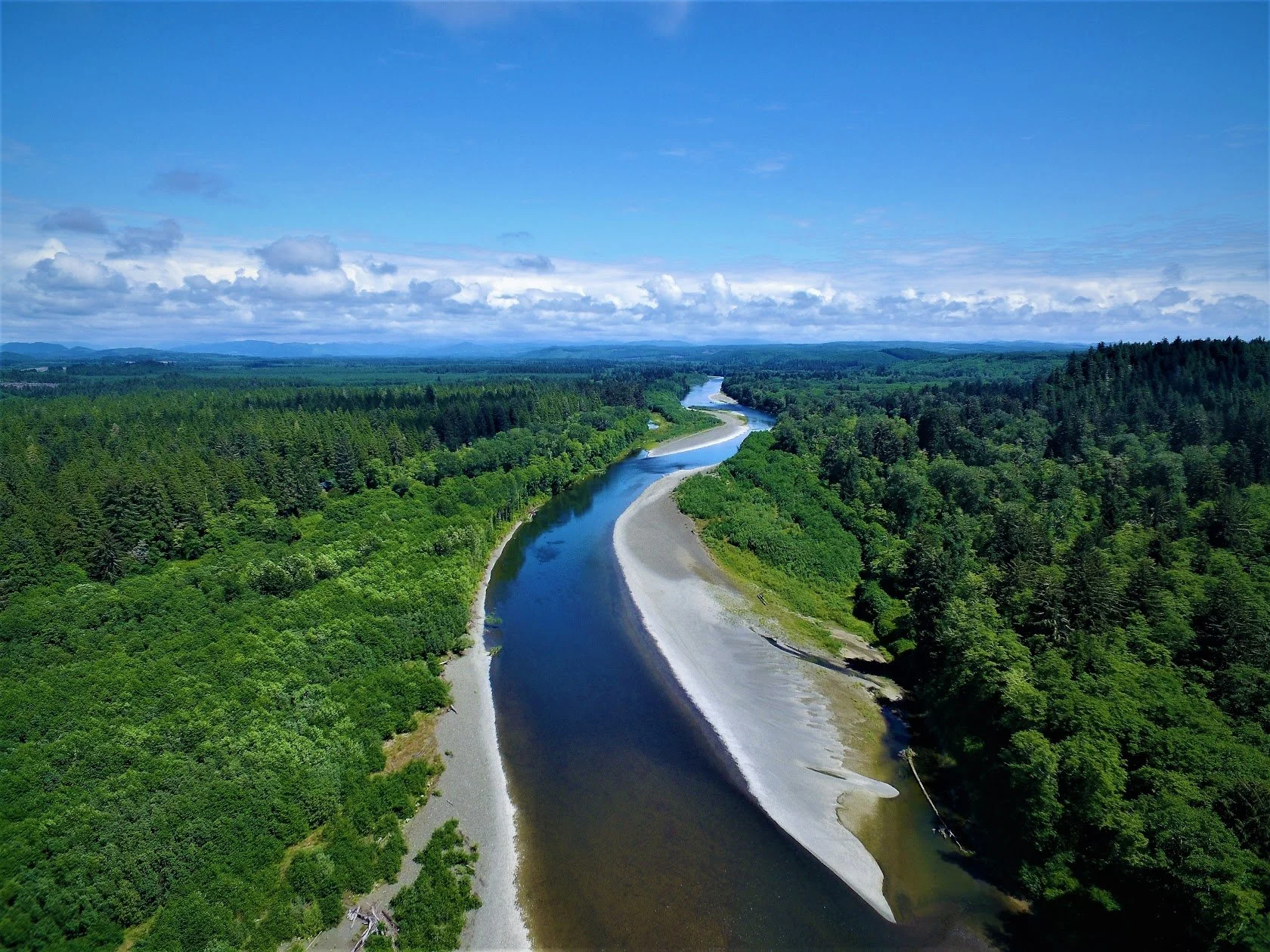
A drone image I took back in 2021 for a grant proposal showing the Quillayute River looking east.
The Quillayute Watershed: Where Everything Comes Together
When I think about my time in Forks, I do not think about one river by itself. I think about the whole Quillayute system, because that is how the landscape works. The Quillayute is short as a mainstem river, but its story is much bigger than its length. It is formed by the rivers that drain the wet forests and valleys around Forks, including the Sol Duc, Bogachiel, Calawah, and Dickey, before pushing toward the Pacific near La Push.
That makes the Quillayute feel less like one river and more like the final sentence in a paragraph written by every tributary upstream.
By the time water reaches the lower Quillayute, it has already picked up the character of the watershed above it. It has carried rainfall off steep hillsides, moved through forested valleys, gathered sediment from banks and tributaries, and responded to floods that rearrange gravel bars, wood, pools, and side channels whether anyone had that on their restoration schedule or not.
From a geomorphology standpoint, that is what makes the Quillayute system so interesting. The watershed is not static. It is constantly being shaped by rain, sediment, wood, floods, slope, valley width, and the way each tributary delivers water into the larger system. One stream may bring colder water, another may bring sediment, another may move wood, and another may provide slower off-channel habitat that becomes important when the main river is too high, too fast, or too exposed.
That is the part of watershed ecology that is easy to miss if you only look at a river as a fishing spot. A watershed is not just the water you see in front of you. It is the forest above it, the roads crossing it, the rain falling into it, the soil holding or releasing sediment, the floodplain giving the river room to spread out, and the small tributaries quietly adding cold water, nutrients, insects, and habitat along the way.
That was the world I stepped into when I worked for the Quileute Tribe as a fish habitat biologist. My work was not about forcing the river to behave or making it look nice in a report. It was about understanding what the system needed to function better for fish and people. Sometimes that meant thinking about culverts and fish passage. Sometimes it meant large wood, side channels, sediment, stream temperature, or floodplain connection. Sometimes it meant sitting through meetings, writing grants, and trying to explain why restoration matters long before anyone sees logs placed in a river.
For the Quileute Tribe, that work carries a much deeper meaning. Salmon and steelhead are not just fish moving through water. They are tied to tradition, harvest, family, food, ceremony, economics, and identity. When you understand that, a restoration project stops being just a project. It becomes part of a larger responsibility to help make sure those fish, and the culture connected to them, are still here for future generations.
That work is still happening today. The Tribe continues to be part of a much larger restoration effort across the Olympic Peninsula, working alongside groups like the Wild Salmon Center, Coast Salmon Partnership, Trout Unlimited, and other tribal, state, federal, and local partners to reconnect habitat and give salmon, steelhead, trout, and other native fish better access to historical spawning and rearing areas. One example of that broader effort is the Cold Water Connection Campaign, which focuses on removing high-priority fish passage barriers, replacing undersized culverts, and reconnecting cold, clean tributaries that fish need as climate conditions, summer temperatures, and heavy storm events continue to change. NOAA has described the campaign as an effort to reopen 125 miles of critical spawning and rearing habitat over the next decade, including work in the Hoh, Quillayute, and Quinault watersheds.
To me, that is what makes this work so powerful. It is not restoration for the sake of restoration. It is practical, on-the-ground work that helps fish reach the places they historically used, helps rivers handle high flows more naturally, supports local and tribal contracting work, and gives these watersheds a better chance to keep producing fish for the people and communities connected to them.
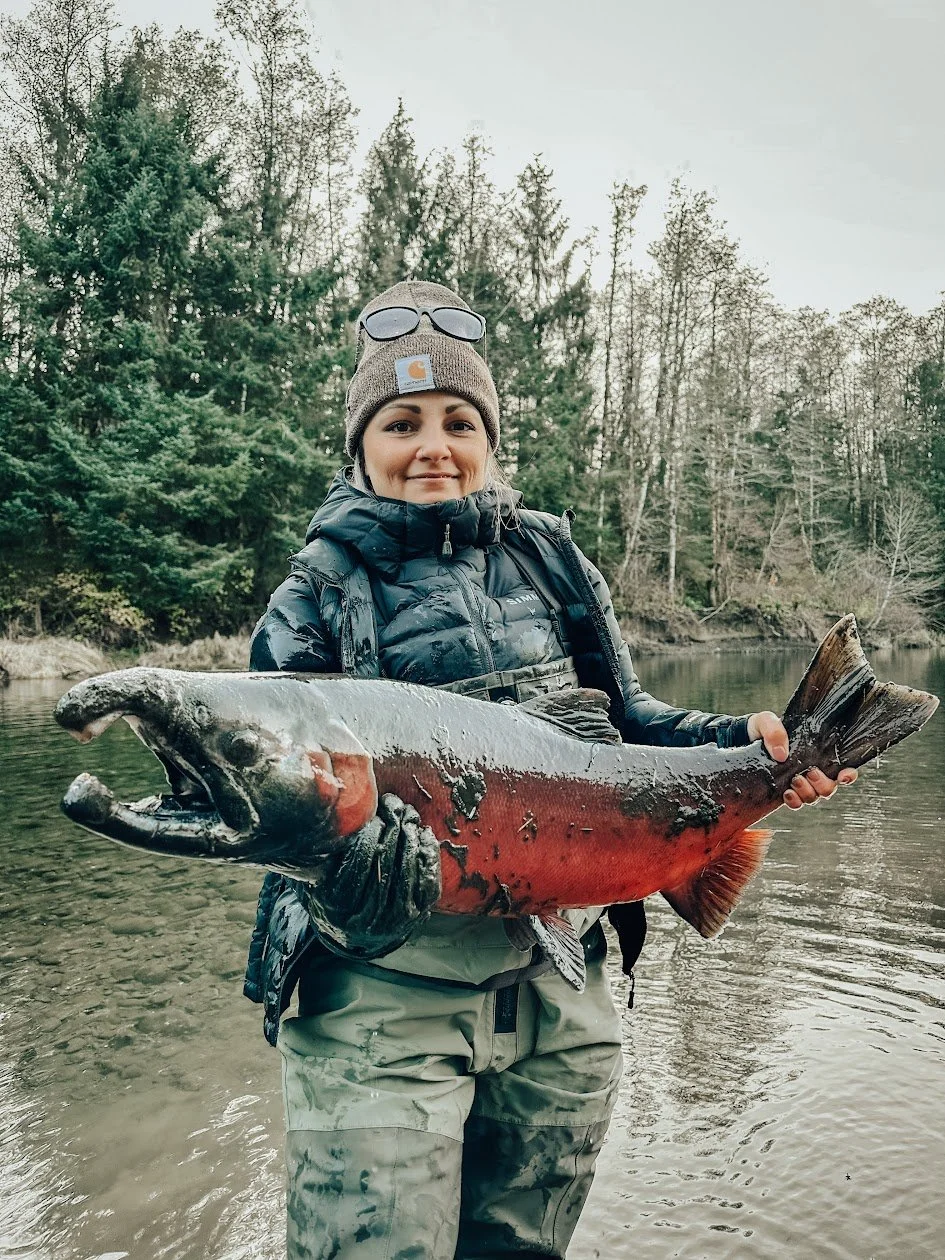
Tanya holding a mean looking coho buck (that might have been dropped a couple times in attempt to get this photo)
The Sol Duc: The Pretty One That Still Means Business
The Sol Duc has always felt different to me.
Some rivers are beautiful because of how they look, but the Sol Duc is beautiful because of how alive it feels. It carries cold, clear Olympic Peninsula water through deep timber, gravel runs, boulder pockets, and classic fish habitat that makes you understand why this region has such a strong river identity. It is the kind of river where you can stand there for a few minutes and feel like there is more happening than what you can see from the bank.
If the Quillayute is where everything comes together, the Sol Duc is one of the rivers that gives the system its cold-water backbone. It has that clean, powerful feel to it, the kind of river where temperature, gradient, gravel, and forest connection all show up in the way the water moves. It is not just fishy because people say it is fishy. It feels fishy because it has the ingredients fish need.
That does not mean every bend is perfect or every reach functions the same way. Rivers are more complicated than that. But the Sol Duc is a good example of how cold water, clean substrate, pool habitat, riffles, wood, and riparian influence can work together to support salmon, steelhead, coastal cutthroat, and the aquatic insects and smaller organisms that feed the whole system.
That is one of the biggest lessons I learned in fisheries work. Fish do not just need water. They need the right kind of water, in the right place, at the right time, connected to the right habitat. Cold water helps hold dissolved oxygen. Clean gravel gives eggs and aquatic insects better conditions. Large wood can create cover, pools, and slower-water areas where fish can rest and feed. Riparian areas can shape stream conditions too, although the exact role depends on the river, the floodplain, the forest type, and how connected the channel still is to the surrounding landscape.
The Sol Duc is also near and dear to my heart because it is where Tanya and I first floated together chasing salmon. That memory has stayed with me because it was one of those days where the river gave us more than just a fishing trip. Of course, we were there to fish, and I am not going to pretend I suddenly became some deeply enlightened river poet who did not care whether we hooked anything.
I cared…a lot. Sometimes probably so much that it was not quite as fun for Tanya as I thought it was.
But there is something about floating through that kind of country with someone you love that changes the way you remember a day. You remember the boat sliding through cold water, the trees leaning over the river, the quiet stretches between spots, and those little conversations that happen when there is no rush to be anywhere else.
You start the day thinking about fish, and you end the day realizing the river gave you something better than just a fish story.
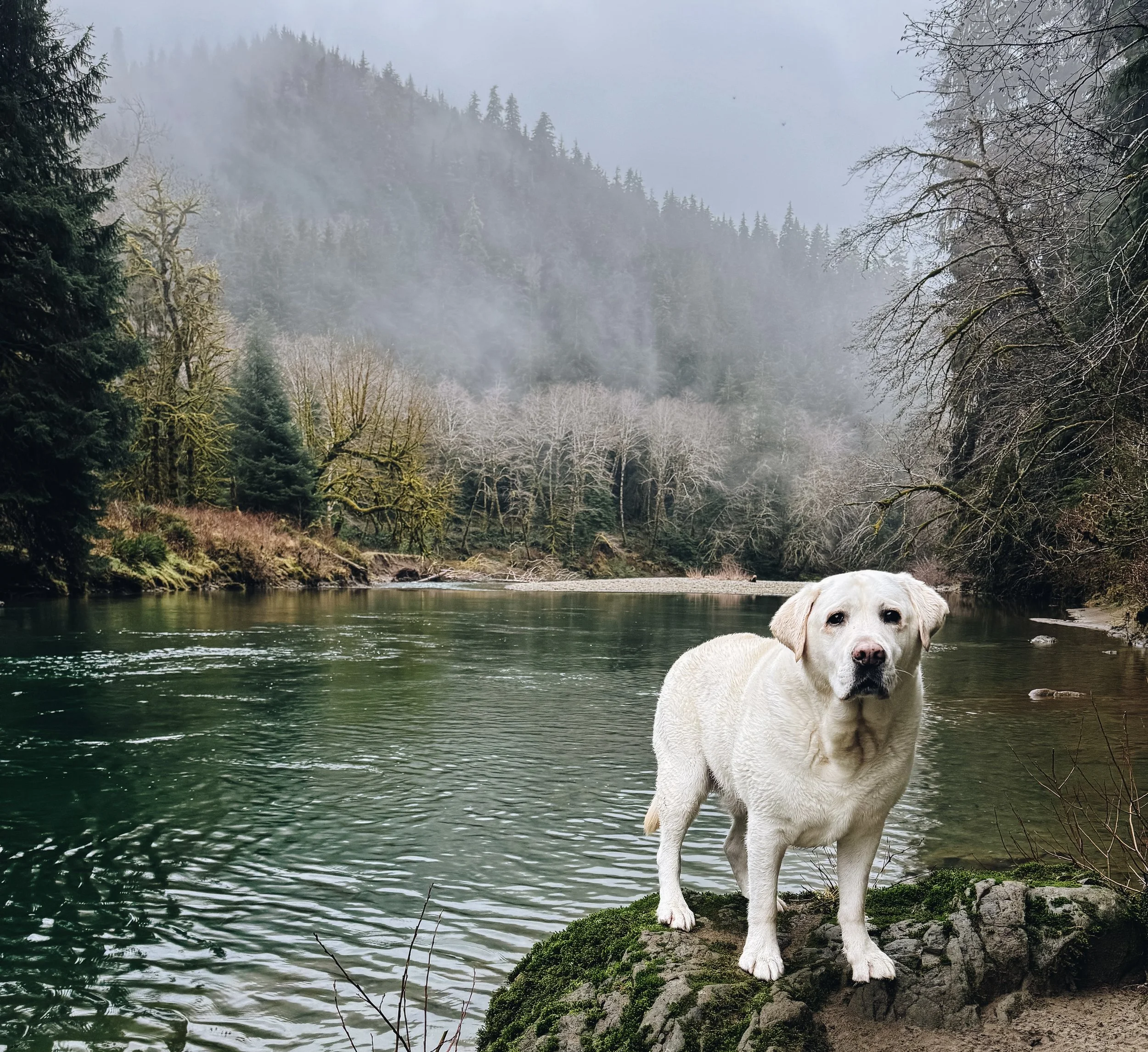
The moody Calawah on a winter morning with Clay standing on the infamous Big Rock (Hole)
The Calawah: The Sharp-Edged One
The Calawah is a different kind of river, and in my mind, it is probably the scariest one.
It has a sharper edge to it, especially when the water is cold, fast, and not particularly interested in whether you make it home with your pride intact. Some rivers invite you in gently. The Calawah feels more like it watches you step in, immediately questions your judgment, and says, “Bold move, buddy.”
From a watershed standpoint, the Calawah feels rugged because it is rugged. It is a river where gradient, flow, boulders, wood, and winter water all seem to have a stronger voice. It does not have the same mood as the Sol Duc, and that is the point. Different rivers build different habitat because they move water, wood, and sediment differently.
For fish, that kind of complexity matters. Salmon, steelhead, and coastal cutthroat all need places to feed, hide, rest, spawn, and survive changing flows, but they do not all use the river in exactly the same way or at the same time. A fast, rough river can look harsh from the bank, but those rough edges can also create pocket water, cover, side margins, and holding areas when the channel has enough complexity to support them.
The Calawah also gave me some of my more intense fishing memories, including a few moments where I found myself pinned up on rocks while chasing winter steelhead and realized very quickly that confidence is not a safety plan. Those are the kinds of moments that become funny later, usually once you are dry, warm, and retelling the story in a way that makes you sound slightly more composed than you actually were.
In the moment, though, there is nothing funny about realizing moving water is stronger than you. There is a reason people say “Old Man River” like the river is some stubborn old guy who has seen a few things, knows more than you do, and has absolutely no interest in your plans for the day.
That river taught me a lot about respect. Not the inspirational poster kind of respect, either. I mean the practical kind where you suddenly understand that slick rocks, heavy current, cold water, and poor judgment can all meet in the same place at the same time.
And yet, that power is part of what makes the Calawah so important.
A river that looks rough, wild, and chaotic to us may be doing exactly what it is supposed to do from a watershed standpoint. High flows move sediment, sort gravel, recruit wood, carve pools, and rebuild habitat. From our perspective, that can look messy and a little terrifying, especially when your relaxing fishing day turns into an unpaid survival class. But from a river’s perspective, that movement is part of the work.
The Calawah gave me fishing stories, near misses, bruised confidence, and probably a few decisions that would not hold up well under a formal safety review. But it also gave me a deeper appreciation for the way fish use powerful water. The fish is never just the fish. It is the whole watershed showing up in one flash, one rise, one grab, or one moment where you suddenly remember that the river is not there for your convenience.
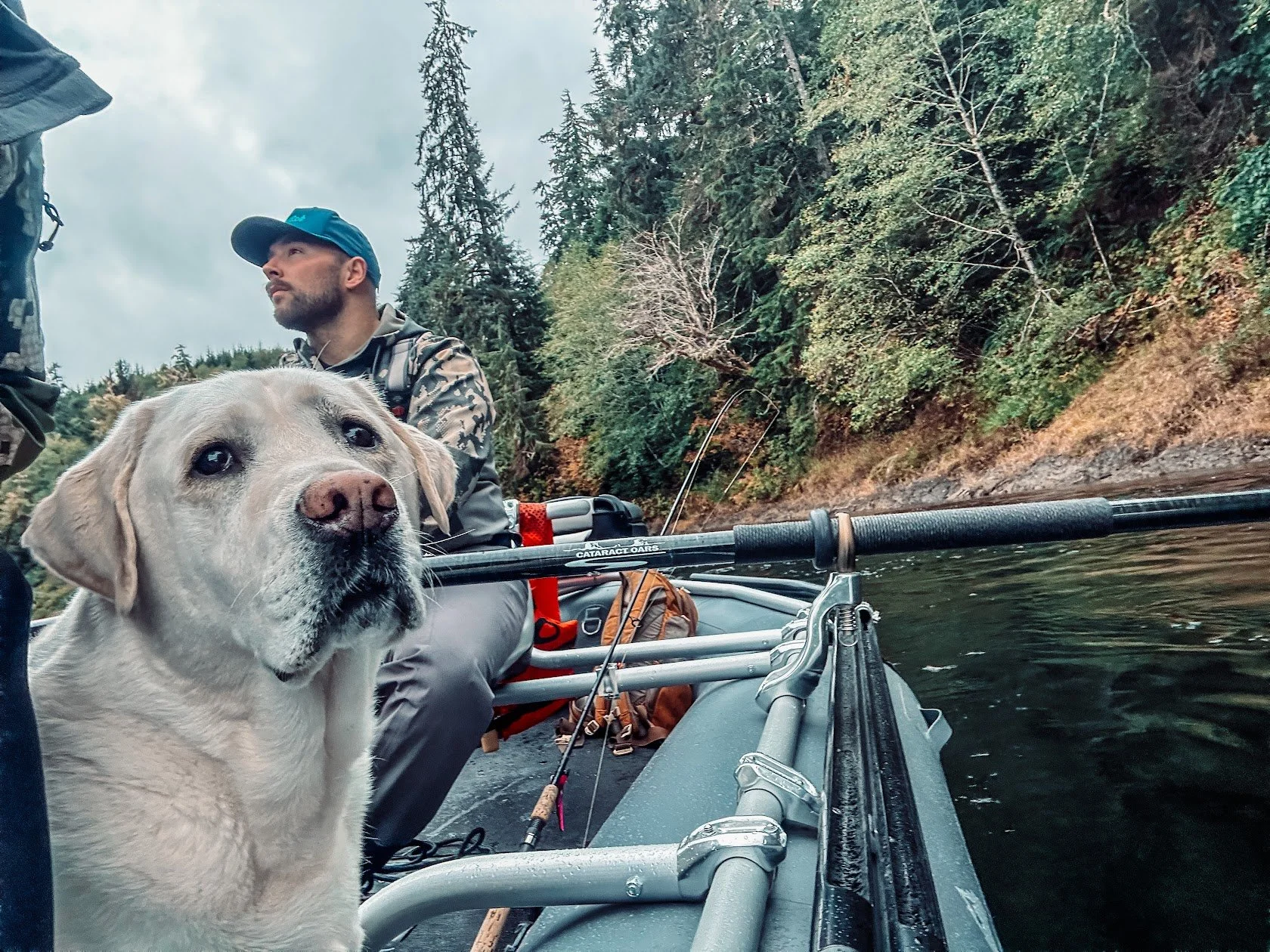
Floating the lower Bogachiel River for some Fall salmon.
The Bogachiel: The Working River
The Bogachiel has always felt like one of those rivers that carries a working landscape with it.
It is not just a wild river tucked away from everything. It is connected to roads, access points, timber history, hatchery conversations, fishing pressure, local identity, and the everyday reality of a community built around rivers. From a watershed standpoint, that makes it incredibly important because it shows the side of river work that is not always clean or simple.
The Bogachiel has a different personality than the Calawah or Sol Duc. It feels more like a river where people and fish are constantly crossing paths. It is productive, accessible, and deeply tied to Forks itself, which means it becomes a place where recreation, restoration, local economy, tribal harvest, conservation, and community use all overlap.
That does not make the river less valuable.
It makes the work more complicated.
This is where fisheries and watershed work become more than biology. It becomes relationship-building, planning, communication, and trying to find a path that respects both the people and the fish. It is easy to say, “protect the river,” but real watershed work happens in specific places with specific constraints. There are roads, culverts, flood risks, landowners, timber lands, funding limitations, historic impacts, and competing needs. There are also people who care deeply about the river, even if they care about it for different reasons.
The same river can mean something different depending on who is standing beside it. For some, the Bogachiel is a place to fish and chase the kind of stories that keep people coming back season after season, while for others it is a cultural resource, a food source, a flood concern, a working landscape, or a place tied to family, memory, and livelihood. That is what makes rivers like the Bogachiel so complicated and so important at the same time.
The Bogachiel also holds a lot of personal meaning for me because it is where one of the more unexpected friendships of my life really took shape. I was in my late 20s, still new enough to Forks to think I had a decent handle on things, and Al Kitchel was a retired dentist in his late 70s who had been born and raised there and knew those rivers in a way you cannot fake. His stories opened my eyes to how powerful the Bogachiel could be, especially how quickly it could rise, change color, move wood, and turn from “that looks fishy” into “maybe we should make better choices” before you even finished your coffee.
Al knew that power personally because he had been battling the river on his own property for years. About one river mile upstream from where the Bogachiel meets the Sol Duc and eventually forms the Quillayute, the river had a way of reminding him who was really in charge. It would chew away at the bank, flood the field nearly every year, and keep reshaping the edge of his place whether he liked it or not. Hearing him talk about it made the Bogachiel feel less like an abstract watershed lesson and more like a living force that people in Forks have to work with, respect, and sometimes just endure.
Al and I spent countless hours swapping stories, drinking peanut butter whiskey, and talking about everything from fish to the bats that roosted in his attic, which is absolutely a story for a different blog. But those conversations gave the Bogachiel a human side for me. It became more than a working river or a fishing river. It became a place tied to friendship, local knowledge, old stories, questionable drink choices, eroding banks, flooded fields, and the kind of perspective you only get from someone who has spent most of his life watching the river do whatever it wants.
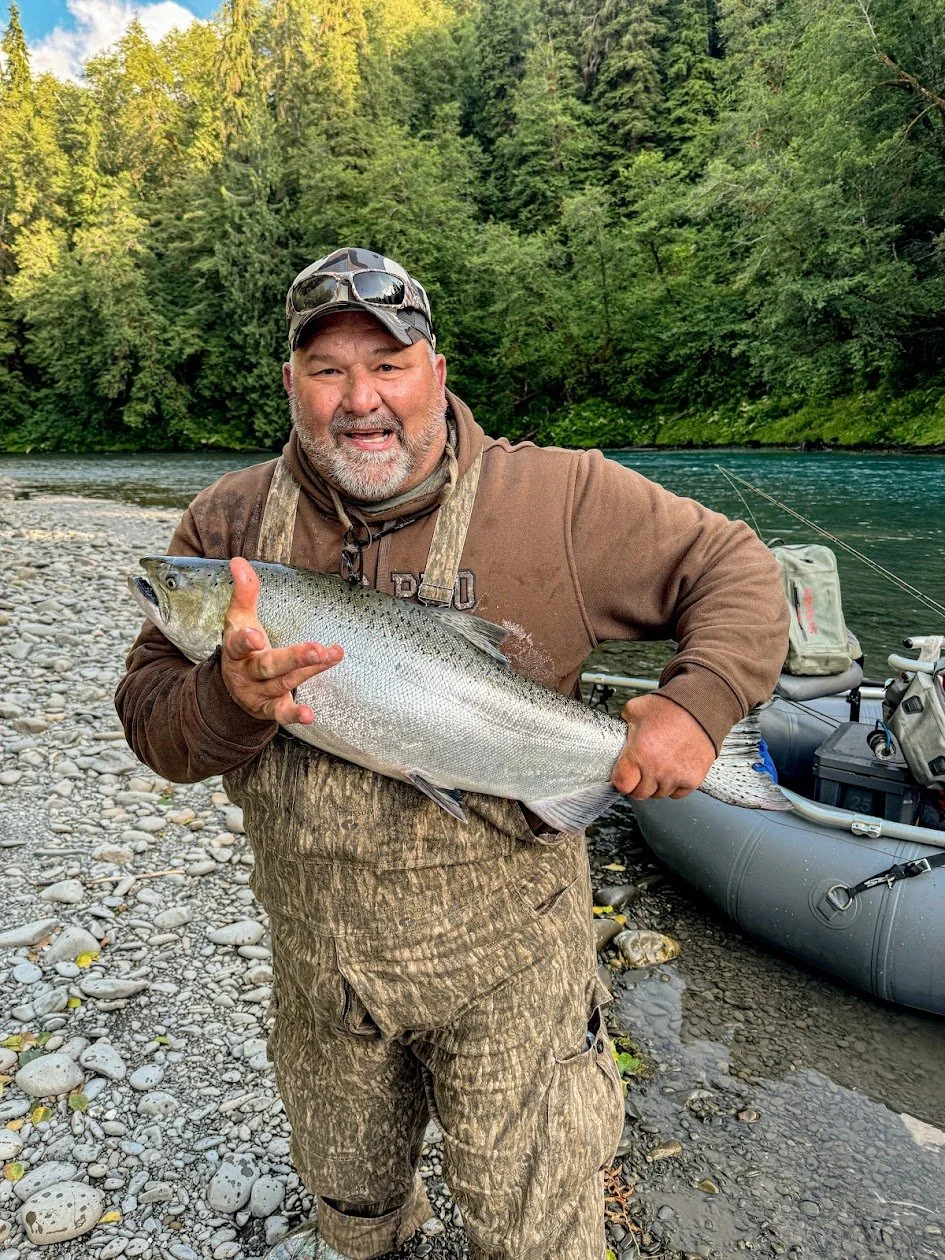
Pops holding his first Chinook (King) Salmon that he caught
The Hoh: The Big, Glacial One That Holds More Than Fish
The Hoh River has a completely different feel from the Quillayute tributaries around Forks.
It is bigger, broader, and shaped by glacial influence, which gives it that powerful, almost ancient character that makes you feel small the second you stand beside it. The Hoh begins high on Mount Olympus, moves through rainforest, gathers cold water and sediment from the mountains, and eventually works its way toward the Pacific. It is one of those rivers where you can see the connection between mountain, glacier, forest, floodplain, and ocean.
The Hoh carries the landscape with it.
That is what makes glacial rivers so fascinating. Their flows are influenced by rain, snow, ice, sediment, and seasonal change, and their channels often shift as that sediment moves downstream. To us, that can look messy, unstable, and hard to predict. To fish, complexity can be the whole point.
Braided channels, gravel bars, side channels, log jams, and floodplain connections all create different places for fish to use depending on flow, season, and life stage. Salmon, steelhead, coastal cutthroat, and the rest of the river’s aquatic life are not looking for a tidy river. They are looking for a living one.
The Hoh also carries some of my strongest personal memories.
I have a lot of memories there with my dad, and the older I get, the more those memories matter. Fishing with your dad has a way of sneaking up on you. At the time, you think the day is about whether the fish are in, whether the river is too high, whether anyone remembered enough snacks, or whether the weather is going to turn on you.
Later, you realize the real gift was the time together.
The river was just the place big enough to hold it.
The Hoh also became part of my story with Tanya. We always enjoyed summer trips there, and those days had a completely different feel from the cold, wet days that define so much of winter on the Peninsula. Summer on the Hoh could feel warm, open, and almost peaceful, at least until the river reminded you that it was still very much in charge.
Then, on July 6, 2025, before we moved to Wyoming, the Hoh became something even bigger for us.
That is where I asked Tanya to marry me.
I do not think I could have picked a place that carried more meaning. It already held memories with my dad, memories with Tanya, and memories of a chapter of life on the Olympic Peninsula that shaped me in ways I probably did not fully understand at the time. Some rivers become important because of the fish. Some become important because of the work. The Hoh became important because it held family, love, transition, and the start of something new.
That is what makes the Hoh such a powerful part of this story.
It is not just another river to describe. It is the place where geomorphology, salmon habitat, rainforest ecology, family memory, and an engagement story all overlap.
That is the kind of connection Clay’s Drift is built around.
Rivers are never just rivers once they become part of your life.
Back to Town
No matter which river the day started on, it always seemed to end the same way.
Cold, soaked, tired, sunburned, humbled, or some combination of all four, we would eventually make our way back into Forks and find our spot at Westend Tip & Sip. That place became part of the rhythm, not because it was fancy or overcomplicated, but because it was exactly what you needed after a day on the water.
You could spend all day getting worked over by the Calawah, floating the Sol Duc with someone you love, listening to old stories about the Bogachiel, or standing beside the Hoh trying to understand how a river can hold that much meaning, and somehow the day always made more sense once you were back in town with a cold beer in your hand.
That is where Clay’s Drift started to come together for me.
The beer at the end of the day was never separate from the river. It was part of the same story. Good water supports salmon and steelhead. Good water supports coastal cutthroat, insects, forests, communities, and cultures. Good water carries family memories, friendships, close calls, and the kind of stories that somehow get better every time they are retold.
And yes, good water makes good beer.
That is really what this next chapter of Along the Drift is about. It is not just where I fished, floated, worked, or nearly made a few questionable decisions in fast water. It is about the watersheds underneath those stories and the people, fish, forests, and small towns connected to them.
Forks taught me that rivers are never just rivers once they become part of your life.
They become teachers, memory keepers, warnings, gathering places.
And sometimes, if you are lucky, one of them becomes the place where you ask the biggest question of your life.
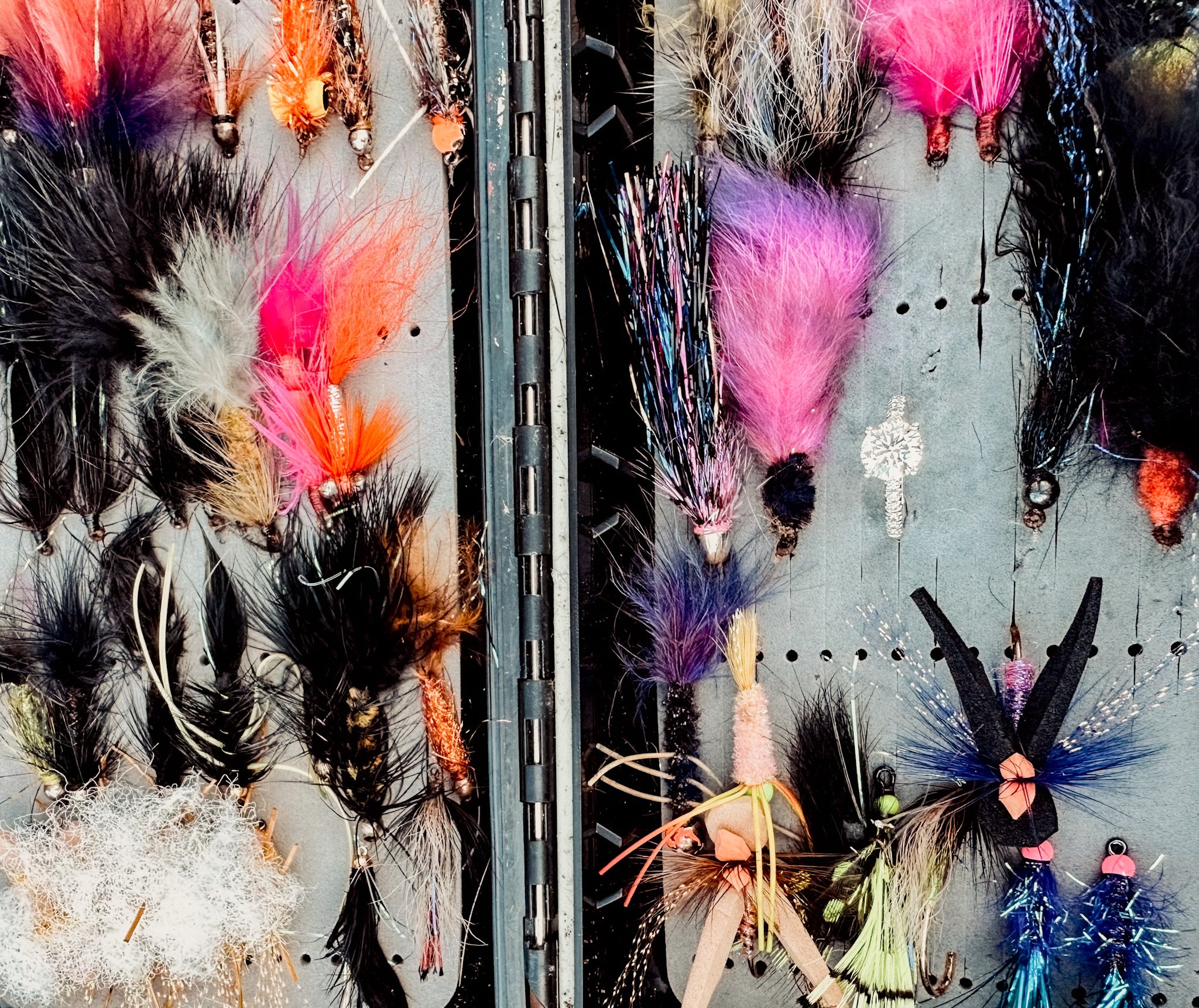
Opening the fly box to choose the next fly, laid the ring that would change Tanya’s (our) life forever
